Are You A Professional Who Works With Alcoholics? AA Can Help.
AA was established in 1935. Approx. 2 million members world-wide. Over 3,000 AA meetings in Western Washington.

Western Washington AA Service Committees have qualified members available to present the AA recovery program to any organization or group.
AA Committee Members are available to speak in person or via online video platforms at schools, universities, businesses, parole and probation offices, DUI classes, health fairs, churches, civic groups, community centers, medical centers, treatment facilities, jails, and any setting where the AA message can make a difference.
We are committed to building and maintaining open communication with professionals about Alcoholics Anonymous — because when we work together, we are more effective in fulfilling our shared purpose: helping the alcoholic who still suffers.
Local Contacts
Alcoholism touches every part of our communities—and every profession. The people you serve, support, and work alongside may be affected.
Alcoholics Anonymous is available as a resource for professionals seeking to better understand alcoholism and connect individuals with help. Upon request, AA members can share information with staff and help facilities explore access to meetings and recovery resources.
In high-demand fields—including healthcare, first responders, and industries like construction where addiction rates are among the highest—access to support can be critical. AA can provide materials, helpline information, and connections to local recovery communities whenever and wherever they’re needed.
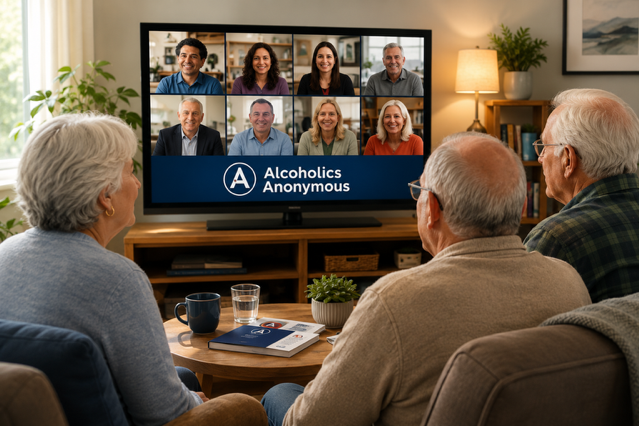
The AA Approach
The AA Approach: Peer to Peer & Non-Professional by Design
AA does not diagnose. Instead, AA makes available the information each person needs to diagnose themselves — because self-diagnosis is the first step out of the delusion that alcoholism creates. The alcoholic must fully concede, from within, that they will never be able to drink normally. Without this concession, lasting recovery is not possible.
AA members broadly understand alcoholism not as a moral failing, but as a progressive illness — one that cannot be cured, but can be arrested. It is understood as a combination of physical sensitivity to alcohol and a mental obsession with drinking that willpower alone cannot overcome.
“Times change, people change, the language may change. But the disease of alcoholism does not change. It always kills.”
-Bill W., co-founder of AA
Recovery: A Program for Living
The path of recovery in AA is built on the Twelve Steps — a practical and spiritual framework that begins with the admission of powerlessness over alcohol and moves toward a profound change in how a person thinks, acts, and relates to the world.
Central to this journey is the concept of a Higher Power. AA requires no particular religion or belief. The program asks only that the individual remain open to the idea that a power greater than themselves could restore what willpower alone could not — however that power is personally understood.
“God grant me the Serenity to accept the things I cannot change, Courage to change the things I can and Wisdom to know the difference.”
Unity: The Fellowship That Makes It Possible
No one recovers alone in AA. The fellowship provides the environment in which recovery takes root. Anonymity is its spiritual foundation. Within the rooms of AA, what is shared stays in the room — creating the safety and trust that allow honest conversation to happen. Publicly, members do not disclose their AA affiliation, ensuring no individual becomes the face of the program. Anonymity also levels the fellowship — titles, professions, and status are set aside. Everyone faces the same problem and seeks the same solution.
“This we owe to A.A.’s future. To place our common welfare first; to keep our fellowship united. For on A.A. unity depend our lives and the lives of those to come.”
Service: Giving Back What Was Freely Given
AA sustains itself through service. The most personal form is sponsorship — a more experienced member guiding a newcomer through the Twelve Steps, sharing experience rather than professional advice. Service extends further: showing up, being present, and passing on what was freely received. This giving back is understood as essential to the recovery of the person offering it, just as much as the person receiving it.
“When anyone, anywhere, reaches out for help, I want the hand of A.A. always to be there. And for that: I am responsible.”
Primary Purpose: Carry the Message to the Alcoholic who still suffers
The primary purpose of A.A. is to carry its message of recovery to the alcoholic seeking help. Almost every alcoholism treatment tries to help the alcoholic maintain sobriety. Regardless of the road we follow, we all head for the same destination, recovery of the alcoholic person. Together, we can do what none of us could accomplish alone. We can serve as a source of personal experience and be an ongoing support system for recovering alcoholics.
Copyright A.A. World Services, Inc. – Information on Alcoholics Anonymous F-2
Family Help
Al-Anon is Here to Help the Loved Ones of Alcoholics.
Alcoholism frequently affects the loved ones of alcoholics. Al-Anon uses the shared experience of its members to help newcomers better understand alcoholism, and find support from others who have faced similar experiences.
Al-Anon Family Groups is a Twelve Step program of recovery. Members are made up of people concerned with someone’s drinking problem.
Starting with the first gatherings of alcoholics in 1935, before the group or organization had a name, the families of alcoholics were meeting and sharing their experience with their loved ones. Loved ones joined their alcoholic family members in their gatherings and together, they sought out ways to support sobriety for the entire family.
Al-Anon Family Groups also provide support for Alateen in many communities. Alateen is for teenagers who have been affected by someone else’s alcoholism.
A Family Solution
Discover Al-Anon & Alateen Here
“I learned ... that I was a sick man emotionally and physically. As every AA today knows, this knowledge can be an enormous relief. I no longer needed to consider myself essentially a fool or a weakling.”
-Bill W., co-founder of AA
Cochrane Study
Study authors are Dr. John Kelly of the MGH Recovery Research Institute and Harvard Medical School, Keith Humphreys of Stanford University, and Dr. Marica Ferri of the European Monitoring Centre for Drugs and Drug Addiction.
We understand that professionals from the medical and scientific community will have interest in professional and scientific data about alcoholism. AA does not oppose outside information about Alcoholism. AA does not endorse or participate in any studies about alcoholism.
These links are provided in the spirit of informing everyone about alcoholism.
-
Summary Article on Stanford, Harvard, EU. Study.
Scitechdaily, Stanford School of Medicine. -
Cochrane Database of Systematic Reviews. Alcoholics Anonymous and
12-Step Facilitation Treatments for Alcohol Use Disorder:
Distillation of a 2020 Cochrane Review for Clinicians and Policy Makers -
Full Study Stanford, Harvard, EU. of AA Success.
Link to full study
Does Alcoholics Anonymous Work?
This short video is a synopsis of the study “Does AA Work” published in March of 2020.
Harvard, Stanford, the European Monitoring Centre for Drugs and Drug Addictions worked together to determine the effectiveness of AA.
The review was published in the Cochrane Database of Systematic Reviews.
For Professionals Working With Youth

Alcoholics Anonymous does not recruit or promote itself in schools. However, AA members are available—upon request—to participate in educational settings alongside professionals, offering firsthand perspectives on recovery.
At the invitation of professionals, AA members have shared with audiences ranging from middle school classrooms to nursing programs, where real-world perspectives on alcoholism complement academic training.
Across Western Washington and around the world, a strong and growing community of young people has found recovery in AA—many in their teens and twenties—building meaningful lives and supporting others.
Too young to be an alcoholic?
AA experience suggests otherwise. Young people who identify with the problem of alcohol have found a solution in AA, often early in life, avoiding years of unnecessary suffering.
For professionals working with youth, AA can serve as a community-based recovery resource. Open meetings may be available for observation, and local AA service committees can connect professionals with members willing to share their experience.
AA is Not Affiliated with any Outside Organizations
No Research. No Opinions. No Affiliations. Just Recovery.
AA maintains no affiliations with outside organizations. It takes no position for or against any other group or organization, and holds no objection to professionals who research or pursue alternative approaches to alcoholism. AA remains neutral on all other matters, including alcohol policy, detoxification, treatment, medical care, social concerns, politics, and religion.
More than 300 Twelve Step programs have been developed based on AA’s original model, each addressing issues other than alcoholism.
Who Are AA Members?
The Primary Purpose of AA is to carry the program of recovery to the still suffering alcoholic.
AA members are individuals who have recognized and accepted that they are unable to manage their drinking despite repeated attempts. They have come to understand that living without alcohol is essential to leading fulfilling, healthy lives. Millions of people struggling with alcoholism have achieved lasting freedom from alcohol.
Alcoholism can affect anyone — regardless of age, race, ethnicity, gender identity, economic background, level of education, or other circumstances.
AA takes no position on alcohol itself. Members have no interest in advocating for alcohol reform or influencing how non-alcoholics choose to drink. Anyone concerned about their own drinking, or that of someone close to them, is welcome to attend an Open AA meeting.
AA members do not push their experiences on others but are willing to share them when invited to do so. Those who have recovered understand that their own sobriety depends on staying connected with fellow alcoholics, sustaining their program of recovery, and bringing the message of hope to those who are still struggling.
Anonymity in AA

Alcoholics Anonymous is not an anonymous organization.
Members of AA protect their anonymity: to protect the AA organization, their professional and private lives, the lives of other alcoholics and most importantly, those seeking help with their drinking problem; the newcomer.
Anonymity is the spiritual foundation of our groups: “Who you see here, what you hear here, when you leave here, let it stay here.”
Myths
Is A.A. religious?
It is a common misconception that Alcoholics Anonymous is a religious-based or Christian organization, but that is not the case. In fact, a fundamental principle of A.A. is that the Fellowship is not affiliated with any religion, nor is it allied with any sect, denomination, politics, organization, or institution.
Is A.A. professionally facilitated?
No. A.A. meetings are peer-led by members with lived experience. There are no clinicians, fees, or case management services provided by A.A.
Is A.A. treatment?
A.A. is not treatment, therapy, or a medical service. It is a mutual-help fellowship that individuals choose to participate in voluntarily.
Does referring to A.A. imply affiliation?
No. Referring someone to A.A. is a cooperative action. A.A. does not affiliate with professional organizations, institutions, or treatment providers.
AA Meetings
Easily find local meetings 24/7 in the Meeting Guide App

The app helps people find A.A. meetings and resources near them. A.A. service entities provide the meeting data for the app. Meeting Guide is available for iOS and Android smartphones.


For a list of local Helplines.
Meetings are free and available globally — in-person, virtual, and by phone. Online formats have substantially expanded access for rural, homebound, and shift-working populations, including first responders and tradespeople working non-standard hours.
For clinicians, attorneys, HR professionals, and supervisors, AA referral is low-cost and immediately actionable. No intake, no waitlist, no insurance required.
AA is best understood not as a treatment but as a sustained recovery support community — one that operates alongside and extends well beyond the formal care or intervention episode.
About Alcoholism
The solution comes from understanding the problem.
Alcoholism is among the oldest and most devastating diseases known to humanity. The challenge of helping the chronic drinker has troubled mankind for millennia. A clearer understanding of alcoholism and its roots can reduce the stigma that prevents alcoholics from seeking the help they need.
Many people assume that personal problems cause alcoholism. AA members recognize that this is not necessarily the case. Problems may produce heavy drinkers or those who drink to cope, and some alcoholics struggle with issues beyond alcoholism itself. Some individuals begin drinking to manage their problems, only to discover they cannot stop through willpower alone. Alcoholism is not a product of problems; alcoholism itself is the problem.
The American Medical Association, the National Council on Alcoholism, and twenty other professional organizations define alcoholism as a disease.
“Alcoholism is a primary, chronic disease with genetic, psychosocial, and environmental factors influencing its development and manifestations. The disease is often progressive and fatal. It is characterized by impaired control over drinking, preoccupation with the drug alcohol, use of alcohol despite adverse consequences, and distortions in thinking, most notably denial. Each of these symptoms may be continuous or periodic.”
Copyright A.A. World Services, Inc. – AA as a Resource for the Health Care Professional. P-23
Other Descriptions of Alcoholism
“Alcoholism, commonly referred to as an alcohol use disorder (AUD) or alcohol dependence disorder (ADD) is a medical condition characterized by an impaired ability to stop or control unhealthy drinking patterns.”
– SAMHSA
The National Institute on Alcohol Abuse and Alcoholism (NIAAA) describes alcohol use disorder as “an impaired ability to stop or control alcohol use despite adverse social, occupational, or health consequences.”
“A person with this condition does not know when or how to stop drinking. They spend a lot of time thinking about alcohol, and they cannot control how much they consume, even if it is causing serious problems at home, work, and financially.”
Heavy or inappropriate drinking is not necessarily the same as alcohol dependence.
Resources
Alcoholics Anonymous World Services, Inc. Publications for Professionals
- If You Are a Professional P-46For professionals of all types who deal with alcoholism and alcohol use disorder, this pamphlet explains how A.A.s and non-A.A.s can work together to help alcoholics stop drinking.
- A.A. in Correctional Facilities P-26For correctional professionals including probation officers, prison administrators, and those in the judicial system who deal with alcoholics.
- A Message to Corrections Professionals P-20This pamphlet offers information about what A.A. is and can do and how groups function in a correctional facility.
- A.A. as a Resource for the Health Care Professional P-23Directed to those in the alcoholism field, this pamphlet provides information about Alcoholics Anonymous and describes some approaches that healthcare professionals use in referring problem drinkers to A.A.
- An Open Letter to Health Care Professionals F-210As a healthcare professional, you are in a key position to provide guidance, education, and support for the still-suffering alcoholic.
- Our Primary Purpose: GSO PodcastThrough interviews with GSO staff and voices from A.A. history and the Fellowship today, we explore how GSO supports A.A. to carry the message of recovery to those who need it most, which is Our Primary Purpose.
- Do you think you have a problem?Alcoholics Anonymous is a fellowship of people who come together to solve their drinking problem.
- A.A. At a Glance F-1Flyer presenting easy-to-read, basic information about the Fellowship of Alcoholics Anonymous.
- Frequently Asked Questions About A.A. P-2Answers many of the common questions people have about alcoholism and A.A.
- Faith Leaders Ask About A.A. P-25Introduction to A.A. for members of the clergy unfamiliar with the Fellowship.
- A.A. and the Armed Services P-50Personal stories tell how men or women in the military — any rank, any age — can beat a drinking problem through A.A.
- Is there a Problem Drinker in the Workplace P-54This leaflet gives a concise description of the help A.A. can offer to the alcoholic employee.
- A.A. as a Resource For Drug & Alcohol Court Professionals SMF-177An overview for drug and alcohol court professionals of A.A. and its services.
- Official A.A. Website - aa.orgThe official website of the General Service Office of Alcoholics Anonymous.
- About A.A. - A Newsletter For ProfessionalsThe newsletter from the General Service Office for professionals who work with alcoholics.
- A.A. Grapevine and La ViñaGrapevine and La Viña are the international journals of Alcoholics Anonymous in print, digital and audio.